Barber family home in Newton
Defending JacobThe Barber family home in Newton is both the family’s domestic refuge and a pivotal crime-scene-like space in Andrew Barber’s account of the investigation into Benjamin Rifkin’s murder. Within its familiar rooms, Andrew discovers a folding knife hidden in Jacob Barber’s bureau; later, as police wait outside for a warrant, he enters the house ahead of them and searches his son’s room. The home’s significance lies in that reversal: a father’s private effort to protect his child turns the family interior into a contested space where care, suspicion, and the justice system converge.
Domestic Space and the Knife
After allowing Laurie and Jacob to leave, Andrew returns to the house and searches Jacob’s room. In the bureau’s top drawer, a hard object lies carelessly wrapped in an old white T-shirt. When Andrew unfolds the shirt, a black-handled folding knife spills onto the bureau. He opens it by holding the blade between thumb and forefinger. Unfolded, it is about ten inches long, with a grippy handle, a hook-shaped serrated blade, and a pointed tip. Its drilled sides and distinctive ripping edge make it look less like an ordinary household object than a weapon designed to wound.
The knife changes the meaning of the room around it. Jacob’s bureau and T-shirt are ordinary belongings, but the concealed blade makes their familiarity newly suspect. Andrew’s discovery does not make him conclude that Jacob committed murder; he later distinguishes his growing suspicion that his son knows more than he has said from any belief that Jacob is a killer. Still, the knife is an unsettling physical fact within a home that had been part of ordinary family life, and it sharpens Andrew’s divided attention as both prosecutor and father.
The House Under Watch
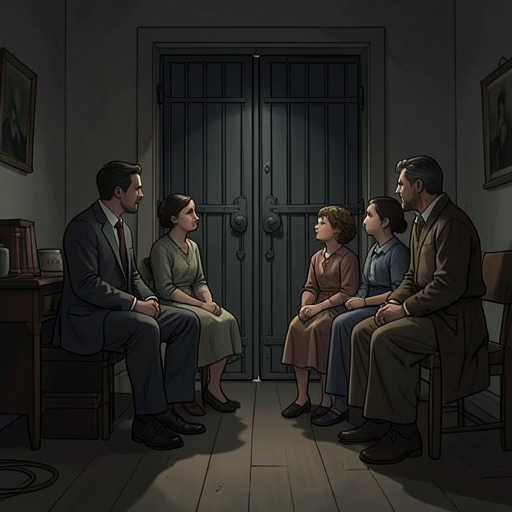
On the day Jacob returns from school, Andrew and Laurie are in the kitchen when they hear him enter through the front hall, shut the door with his heel, and put down his backpack and coat in the mudroom. They exchange nervous glances, listening to familiar household sounds as if those sounds might disclose what Jacob knows. Laurie calls him into the kitchen; after a brief pause, he agrees. The home remains the setting for family conversation, but the parents’ interpretation of its small sounds has changed: arrival itself becomes something to monitor.
The police presence transforms the house more openly when Andrew gets home too late to prevent the search. Four Newton cruisers are already parked outside, holding the house while officers wait for the warrant. The property’s position beside a suburban commuter-train stop gives Andrew an unconventional route in: an eight-foot fence separates the platform from the backyard, and he climbs over it, pushes through arbor vitae, and runs across the lawn. A neighbor gardening in his own yard waves; Andrew waves back by reflex as he hurries past. This brief, ordinary exchange sits against the extraordinary urgency of his return.
Andrew’s Search and the Warrant
Inside, Andrew calls quietly for Jacob, hoping to prepare him for what is coming, but nobody is home. He bolts upstairs and searches Jacob’s room, opening drawers and the closet and tossing aside laundry in the hope of finding something incriminating and removing it. His actions are not presented as a discovery of new proof; they are an attempt to intervene before the police search begins. The distinction matters to Andrew, who argues that he is trying to protect an innocent son from a fallible system rather than conceal guilt.
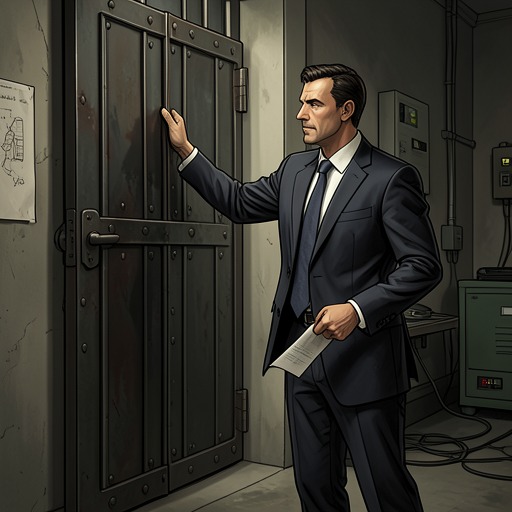
Andrew considers hiding Jacob’s laptop but leaves it in place. Because Jacob has been publicly accused on Facebook, a missing computer could itself appear suspicious; yet the device might contain damaging material if the police find it. The decision remains unresolved in the rush. The doorbell then ends Andrew’s brief, unauthorized search. Paul Duffy, once Andrew’s friend, is at the door with the warrant. Troopers in blue windbreakers and police cruisers with flashing lights fill the scene as Duffy hands Andrew the folded document and tells him to wait outside. The home is no longer simply Andrew’s to search: the warrant brings the state into the private space, while Duffy’s presence makes the collision personal as well as official.
A Contested Family Interior
The house holds two distinct forms of searching. Andrew’s earlier search uncovers the knife, an object that unsettles his understanding of Jacob without convincing him that Jacob is a murderer. His later search is hurried and protective, undertaken before officers can enter. In both episodes, the same bedroom is treated as a place where the truth might be materially present, but the searches are driven by different fears: first the fear of what Jacob may be hiding, then the fear of what the authorities might find or infer.
The home’s narrative role is therefore not that of a neutral backdrop. Its ordinary architecture—the bureau, the mudroom, the stairs, the yard, and the boundary fence—organizes the movement from family intimacy to investigation. A knife hidden among clothes becomes a clue; everyday sounds become objects of anxious interpretation; the yard becomes a route around waiting police; and the front door marks the moment Andrew’s efforts give way to the warrant. By bringing the search into the family’s own rooms, the episode makes the investigation’s pressure tangible: the question of Jacob’s guilt enters the place where his parents have tried to know and protect him.